The Orchestrator: Conducting the Phoenix Revolution in Animal Welfare
Have you ever had the experience of watching a live symphony orchestra and realizing the most important person on stage might be the one who never plays a single note? At first glance, the conductor can seem almost incidental (just a person in formalwear waving a baton around). But then the music shifts. A transition lands perfectly, the tempo tightens, the emotion swells, and suddenly you can feel that this isn't just a group of talented musicians playing at the same time. It's a single, coordinated force.
That’s the moment the role of the conductor clicks. They aren’t just keeping time. They’re engineering the soul of the music.
Fast forward to today; I find myself standing at a very different kind of podium. If you’ve been keeping an eye on the tech world lately, you’ve probably heard the buzz about "agentic agents" (and yes, it sounds like a redundancy, but stick with me). The role of the traditional developer is undergoing a seismic shift. We are no longer just "typists" of code; we’ve become The Orchestrators.

From Coding to Conducting
You might be wondering, what exactly does an orchestrator do in a world where AI can write its own functions? Well, it’s the difference between someone who can play a few chords on a guitar and someone who can lead the New York Philharmonic through a masterpiece.
The future is an app-revolution, but that doesn’t mean just anyone with a prompt can create a masterpiece. The human element is as important as ever, perhaps even more so. We are now navigating and engineering the direction of multiple, specialized AI agents. Think of these agents as the different sections of an orchestra:
The Logic Agents are your strings, providing the core melody.
The Data Agents are the percussion, keeping the rhythm of information flow.
The Safety and Ethics Agents are the brass, punctuating the performance with necessary boundaries.
But without a conductor, a human with imagination, experience, and a vision, you don’t get a symphony. You just get noise.
"The developer’s leverage now comes from designing systems that do the coding, not just writing the code themselves. We are building the 'conductor’s score' for the next generation of enterprise applications."

The Constitution of the Living App
In 2024 and 2025, we began seeing the first true "Living Apps." At The Animal Welfare App, we’ve taken this a step further with our Phoenix Edition. Excusing the tech jargon (and yes, I used sexy to describe tech in the past, and I’ll do it again because this is the sexiest advancement we’ve ever seen), Phoenix isn't just a static tool. It’s a responsive, intelligent ecosystem.
But here’s the kicker: for a "living app" to work safely in a zoological setting, it needs a Constitution.
We spend our days designing the rules, the logic, and the "red-light responsive" boundaries that ensure these AI agents serve the mission of animal care without going off-script. Orchestrating an enterprise app for a multi-million dollar aquarium or a sprawling wildlife sanctuary is not just for anyone. It requires a deep understanding of animal welfare, a flair for complex systems, and the ability to compose a "score" that agents can follow with silky smooth precision.
The Phoenix Revolution: Empowering the Front Lines
So, why "Phoenix"? Because we are rising from the ashes of traditional, clunky, "check-the-box" software. The Animal Welfare App - Phoenix Edition is designed to be exciting, enriching, and empowering.
Imagine a system that doesn't just store data but thinks along with you. Our AI Visual Monitoring and RAG (Retrieval-Augmented Generation) agents allow keepers and veterinarians to interact with their data as if they were talking to a colleague.
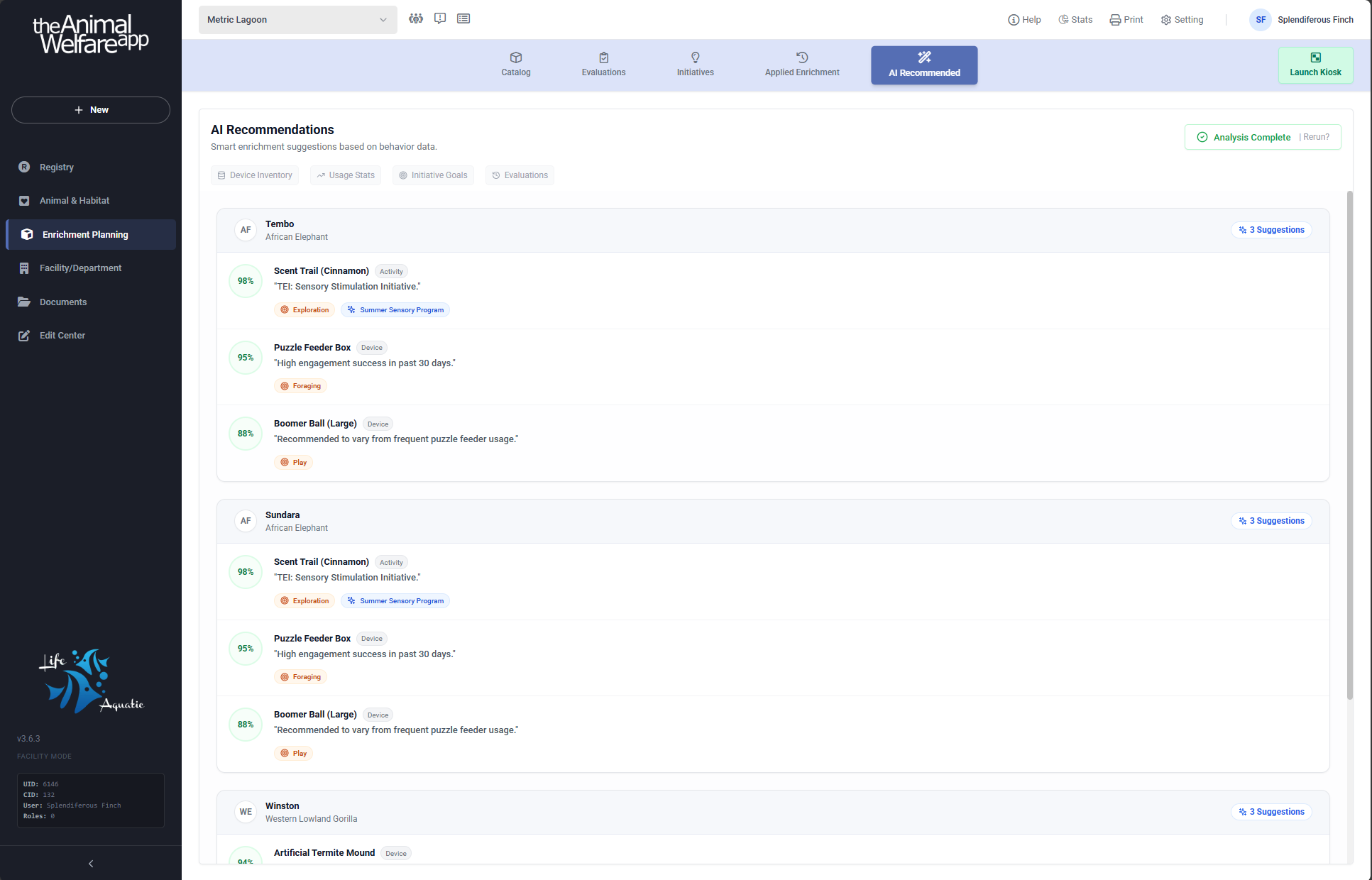
Speed aside for the moment, the real benefit is the quality of life for the animals. When our AI Recommendations Page suggests a specific enrichment device for an African elephant based on its unique behavioral history and the current weather patterns, that’s the symphony in action. It’s not just a feature; it’s a direct contribution to that animal's welfare.

Why the Human Touch Still Wins
Is your management system alive? (I've asked this before, and the answer is increasingly "yes"). But even the most advanced "living app" needs a heartbeat.
The orchestrators at the podium: our developers and animal care experts: are the ones who ensure the technology stays mission-driven. We are the ones who decide the "why" and the "what," while the agents handle the "how."
Designing a masterpiece requires a skill that isn’t common. It’s about:
Problem Framing: Knowing that a dolphin’s health isn't just about a blood pull, but about the interplay of environment, social dynamics, and nutrition.
Ethical Governance: Ensuring AI never replaces the professional judgment of a vet, but supercharges it.
Innovative Imagination: Dreaming up features like our Dive Module or Voice Records before the users even know they need them.
A Prophetic Note on Species Preservation
Let’s be real for a second. We aren’t just building "cool tech." We are in a race against time. Species preservation and habitat protection are the most critical challenges of our generation. Modern zoos and aquariums are the front lines of this effort.

If we want to save species, we need to not only provide the best care possible, we need understanding that meets the challenges of the modern world. This starts with the best tools. The Phoenix Edition is our way of handing the baton to the real heroes: the keepers, trainers, and scientists: and giving them a symphony to lead.
The app store’s days are numbered; the era of the Living Orchestration is here. We are moving from a world where we spend time on computers to a world where computers truly empower us to focus on what's right in front of us.
That is the true masterpiece.
Ready to see the Phoenix in action? Whether you’re managing a pod of dolphins or a troop of primates, it’s time to step up to the podium. Explore our specialized modules and join the revolution in animal welfare.

Comments